
The Brétigny-sur-Orge Derailment: What It Reveals About Fastener Reliability in Rail Joints
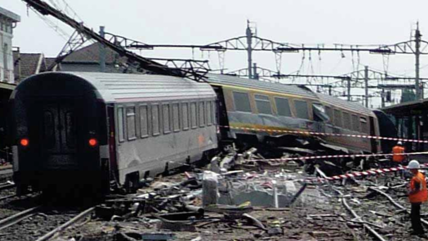
What can one failed fastening component teach us about the future of railway safety?
In our latest article, we are exploring the lessons learned from Brétigny-sur-Orge (one of France’s most significant railway accidents), and discuss how technologies such as Staytite’s Hardlock Nuts are helping engineers address the challenge of maintaining secure bolted connections in demanding rail environments.
On 12 July 2013, Intercités train No 3657 was operating a scheduled long-distance passenger service on the Paris–Orléans–Limoges–Toulouse (POLT) main line, a principal rail corridor connecting Paris with central and southern France.
As the train approached the northern entrance to Brétigny-sur-Orge station, the character of the railway began to change. The continuity of plain line gave way to a more complex environment: a point and crossing layout, where rails intersect, diverge, and rely on precise geometry maintained through a combination of rail form and bolted connections.
It is here that the track becomes less forgiving, where small imperfections are absorbed less easily, and where wheel–rail interaction becomes more concentrated and severe. Within this transition zone, something went critically wrong.
The subsequent sequence of events was later formally established during the investigation into the Brétigny-sur-Orge derailment.
What went wrong?
From an engineering perspective, a switch and crossing are not simply a section of track. It is one of the most mechanically demanding environments in railway infrastructure.
Unlike plain line, where rails provide continuous support and guidance, a crossing introduces deliberate discontinuities. Wheels must traverse gaps, negotiate geometry changes, and remain controlled through a system that depends on precise alignment of multiple interacting components.
To make this possible, the system relies heavily on bolted joints.

Fishplates, or tight plated joints, clamp adjacent rail sections together, maintaining alignment and enabling load transfer across rail ends. When correctly installed and maintained, they provide a stable and robust connection under repeated dynamic loading.
However, this stability depends on a single critical condition: the joint must remain fully secured, maintaining clamping force over time. In railway tracks, the steel rails expand when hot and contract when cold. That movement is unavoidable because steel changes length with temperature.
At Brétigny-sur-Orge, that security had been lost. Cracking had developed, gradually altering how loads were distributed through the jointed assembly. As the rail deteriorated, increasing stress was transferred into the bolted connection.
Under repeated loading from passing trains, this change in load path began to affect the fasteners. One bolt fractured, reducing clamping force across the joint. With restraint weakened, the remaining bolts were subjected to higher loads and less stable conditions.
Over time the fishplate rotated into the wheel passageway during the train’s passage. The structural joint component had become a direct physical obstruction within the wheel path and launched the train off the track. The first two derailed cars remained on track 1 and eventually lay on their right side. The third derailed car went across between tracks 1 and 3 and swept platform 3 for about 100 metres. The last car stopped on platform 3, without lying down.
Tragically, seven people lost their lives and 428 were injured in the incident.
Why do rail fasteners loosen under vibration?
The critical lesson is not just about the joint itself, but about vibration-driven loosening.
Rail environments expose fasteners to:
- Continuous cyclic loading
- Impact forces at crossings
- Thermal movement of rail
- Long-term vibration fatigue
Once preload is lost, joints begin to work loose progressively. In this condition, conventional nuts can unwind over time unless positively locked.
How can Hardlock Nuts change the outcome?
Hardlock Nuts are a type of vibration resistant fastener designed specifically to resist self-loosening under vibration.
Unlike standard fasteners that rely only on friction, Hardlock uses a mechanical wedge-locking principle. This means:
- They do not loosen under vibration
- They maintain preload over long service life
- They remain stable in thermally active joints
- They reduce reliance on re-torquing and reactive maintenance
In short: if Hardlock fasteners are correctly installed, the kind of progressive loosening seen in degraded tight plated joints is far less likely to occur.
Standards and industry response
For infrastructure managers operating similar assets, including Network Rail, the event highlighted a shared vulnerability: in switch and crossing systems, small losses in fastener integrity can escalate into system-level failure when occurring in the wrong geometric and loading context.
Following the 2013 Brétigny-sur-Orge derailment, the Rail Safety and Standards Board (RSSB) queried Network Rail about the potential risk of loose fishplate fasteners within the UK rail network. In response, Network Rail launched a programme to evaluate anti-loosening systems for tight plated joints. This work ultimately led to the approval and rollout of Hardlock Nuts for certain fishplate applications, formalised under Network Rail’s Certificate of Acceptance PA05/02077 for use in approved rail joint configurations.

13 years on
We are now more than a decade on from Brétigny, yet many legacy tight plated joints remain in service without upgraded locking systems.
That means the same underlying risk factors still exist:
- Vibration
- Thermal movement
- Preload loss over time
- Progressive loosening in high-stress areas
The Brétigny-sur-Orge derailment demonstrates how bolted joint reliability and rail safety depends on the long-term integrity of seemingly simple but safety-critical components.
The key distinction is simple. Loose or degrading joints create movement, fatigue and escalating risk, while properly locked tight-plated joints maintain stability under vibration and temperature cycling.
How we can help
Hardlock Nuts provide a way to make that second condition far more reliable in practice: Hardlock Nuts – Staytite, supplying fasteners, C-class parts, Consumables, PPE, and much more besides to manufacturing & production facilities across the globe.
As a supplier of Hardlock Nuts, Staytite helps ensure correct assembly practices, including proper bolt tensioning and alignment. We provide engineering support for rail infrastructure projects, including free on-site installation support for Metric Fishplate Kits.
Read more here: https://staytite-rail.com/fishplate-conversions/
The Staytite Rail team also supplies a wide range of fasteners and engineered components for rail applications, supporting both standard and nonstandard requirements. In addition, we can assist with heritage specific rail systems where legacy track geometry or nonstandard specifications require tailored fastening solutions.

Frequently asked questions
Are Hardlock Nuts approved for use on UK railways? Yes. Hardlock Nuts hold Network Rail Certificate of Acceptance PA05/02077, issued following an evaluation of anti-loosening systems for tight plated joints, and are approved for certain fishplate applications.
What makes Hardlock Nuts different from standard locknuts? Hardlock Nuts use a mechanical wedge-locking principle rather than friction alone, so they maintain preload and resist self-loosening even under sustained vibration and thermal cycling.
For more information email us at rail@staytite.com or call 0300 373 9029 to discuss your requirements.